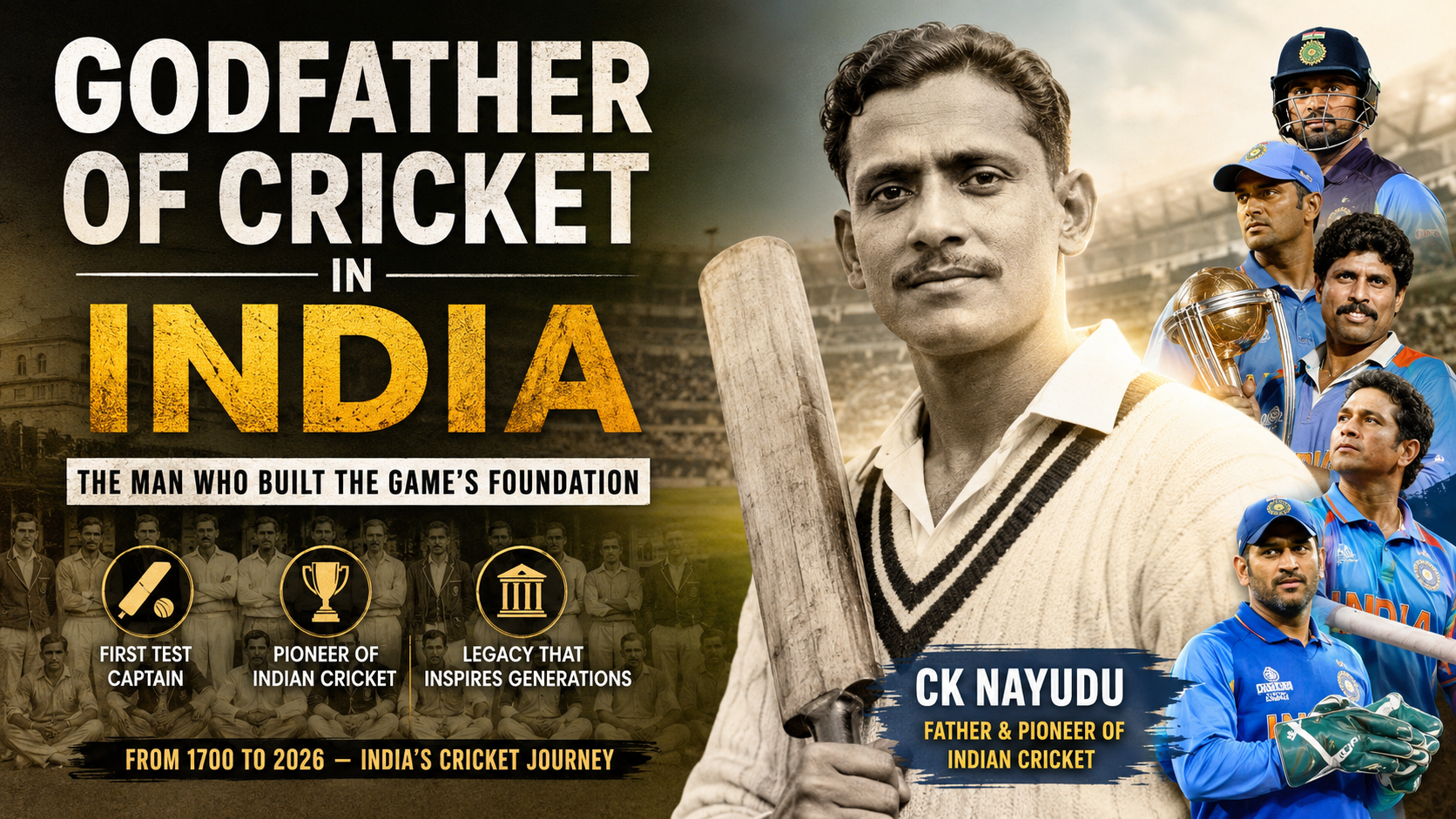
Godfather of Cricket in India (1700-2026): The Man Who Built the Strong Game’s Foundation
Ask ten cricket fans who the godfather of cricket in India is, and you will likely get ten different answers. Some will say Sunil Gavaskar, because he taught India how to bat with patience and pride against the fastest bowlers in the world. Others will say Kapil Dev, because he handed India its first World Cup and, with it, a new identity. Many younger fans will point to Sachin Tendulkar or MS Dhoni, the two names most responsible for turning cricket into the closest thing India has to a national religion.
But if the question is asked in its truest sense not “who made Indian cricket popular” but “who actually gave Indian cricket its shape, its first heroes, and its first sense of belonging on the world stage” the answer takes us back much further than the players most fans grew up watching. It takes us to the 1920s and 1930s, to a tall, powerfully built batsman from Nagpur named Cottari Kanakaiya Nayudu, better known simply as CK Nayudu.
This article explores the phrase godfather of cricket in India from every angle: its informal, debated nature; the historical case for CK Nayudu as Indian cricket’s founding figure; the modern players who are often given the same title by fans and journalists; and how India’s cricketing journey moved from a colonial-era pastime to a global powerhouse. Along the way, we will look at the early history of the game in the country, the difference between “father” and “godfather” as used in cricket writing, and the legacy that continues to shape Indian cricket today.
Godfather of Cricket in India: Quick Facts
| Fact | Details |
| Topic | Godfather of Cricket in India |
| Key Personality | CK Nayudu |
| Full Name | Cottari Kanakaiya Nayudu |
| Born | 1895, Nagpur, India |
| Sport | Cricket |
| Era | 1920s–1930s |
| Major Achievement | India’s first Test captain |
| Historic Moment | Led India in its first Test match in 1932 |
| Famous Innings | Century against MCC in 1926 |
| Major Contribution | Helped establish India’s early international cricket identity |
| Also Known As | Father/Pioneer of Indian Cricket |
| Official Title? | No — “Godfather of Cricket in India” is an informal title |
| Legacy | CK Nayudu Lifetime Achievement Award |
Who Is the Godfather of Cricket in India?
In the most historically grounded sense, CK Nayudu is widely regarded as the godfather of cricket in India. He was India’s first Test captain, the first Indian batsman to earn genuine respect from English crowds and cricket writers, and the player most credited with giving Indian cricket its earliest sense of confidence and identity on the international stage.
That said, it is important to be upfront about something: “Godfather of Cricket in India” is not an official title. There is no governing body, no BCCI resolution, and no universally accepted record that formally hands this label to any one player. It is a phrase used loosely by fans, journalists, and content writers to describe whichever figure they feel had the most defining influence on the sport in the country. Depending on the era and the person you ask, the title has been applied to CK Nayudu, Lala Amarnath, Sunil Gavaskar, Kapil Dev, Sourav Ganguly, and even Sachin Tendulkar or MS Dhoni.
This is why opinions on the subject differ so widely. Cricket fans who grew up in the 1970s and 1980s tend to associate the term with Gavaskar’s era-defining batting. Fans who came of age during the 1983 World Cup naturally think of Kapil Dev. Those who watched Indian cricket transform in the 2000s point to Ganguly’s aggressive captaincy or Tendulkar’s global stature. Meanwhile, cricket historians and writers who study the roots of the game in India consistently point further back — to the 1920s and 1930s, and to CK Nayudu.
Historical sources on early Indian cricket, including accounts of India’s first Test match in 1932, consistently describe CK Nayudu as the player around whom the entire Indian team was built, both as a batsman and as a symbol of what an Indian cricketer could achieve against the best teams in the world. It is this combination of on-field brilliance and foundational influence that has led historians to treat him as the true starting point of Indian cricket’s story — the figure from whom everything else follows.
Also read this:
Why Is He Called the Godfather of Indian Cricket?
CK Nayudu’s claim to the title rests on more than nostalgia. His contribution to Indian cricket touches nearly every area that defines a sport’s early development.
He gave Indian cricket its first international contribution. Long before India was granted Test status, Nayudu’s performances against a visiting MCC team in 1926 — including a blistering, fearless century — convinced English cricket administrators that Indian cricketers deserved a place on the world stage. That single innings is often cited as the moment Indian cricket announced itself to the world.
He played a defining role in establishing cricket in India as a serious, organised sport. At a time when the game was still associated primarily with British colonial clubs and regional princely patronage, Nayudu’s rise gave Indian cricket a genuine national hero — someone ordinary Indians, not just the aristocracy, could admire and follow.
His influence shaped the players and culture that came after him. Nayudu’s fearless, attacking style of batting set a template that later generations of Indian batsmen would draw from. His discipline, physical fitness, and professionalism at a time when the game was still semi-amateur helped raise the standard for everyone who followed.
His long-term impact on Indian cricket’s development cannot be overstated. He captained India in its first-ever Test match, mentored younger players through the princely state cricket structure, and continued playing first-class cricket into his sixties — a testament to both his fitness and his devotion to the game. The Indian cricket board’s highest lifetime achievement honour, the CK Nayudu Lifetime Achievement Award, is named after him precisely because of this enduring legacy.
Taken together, these contributions are why writers describe him not merely as a great player, but as the godfather of cricket in India — a figure whose influence quietly runs through every chapter of Indian cricket that came after.
Early History of Cricket in India
To understand why a player from the 1930s still gets called the godfather of cricket in India nearly a century later, it helps to look at how the game actually arrived in the country.
Cricket reached Indian shores in the 1700s, brought by British sailors and traders of the East India Company. The earliest recorded matches were played by British expatriates for their own entertainment, with little to no Indian participation. For much of the 1700s and 1800s, the game remained an almost exclusively British affair, played on colonial club grounds in port cities like Bombay, Calcutta, and Madras.
Indian participation grew gradually through the 1800s, largely through the Parsi community of Bombay, who were among the first Indians to take up the sport seriously. Parsi cricket clubs were formed as early as the 1840s and 1850s, and by the late nineteenth century, Parsi teams were touring England and playing competitive matches against British sides. This period also saw the rise of communal cricket tournaments and contests organised along community lines such as Parsis, Hindus, Muslims, and Europeans which, while a product of colonial-era social divisions, nonetheless gave Indian cricketers a structured, competitive environment to develop their skills.
Early Indian cricket clubs sprang up throughout the country in this period, often patronised by princely states whose rulers saw cricket as both a fashionable pursuit and a way to build goodwill with the British administration. Many future Indian cricket stars, including CK Nayudu himself, first developed their game playing for teams backed by princely patrons such as the Maharaja of Holkar.
By the early 1900s, Indian players had begun appearing in representative matches against touring English sides, and a genuine domestic cricket culture — though still fragmented and regional — had taken root. This was the environment into which CK Nayudu emerged, and it set the stage for India’s eventual entry into Test cricket.
First Indian Cricket Team and Early Leaders
India’s entry into international cricket came formally in 1932, when the country played its first-ever Test match against England at Lord’s. This was a landmark moment — India became the sixth nation to be granted Test status, following England, Australia, South Africa, West Indies, and New Zealand.
The captain chosen to lead this historic team was CK Nayudu. His selection was not a formality; it reflected the standing he had already earned through years of dominant performances in domestic and representative cricket, including that famous 1926 century against the MCC. As captain, Nayudu was tasked with leading a squad drawn from across British India’s fragmented cricket structure — players from different provinces, princely states, and communities, brought together for the first time under a single national banner.
India’s early cricket captains after Nayudu, including players like the Maharajkumar of Vizianagram and later Vijay Merchant and Lala Amarnath, each built on the foundation Nayudu had laid, but it was Nayudu who set the tone: an aggressive, self-assured approach to Test cricket that refused to treat English opposition with excessive deference. This mindset — the belief that Indian cricketers belonged on the same field as anyone else in the world — became a defining thread running through the early development of Indian cricket, even during a period when results on the field were often difficult, given India’s limited exposure to top-level competition and lack of consistent institutional support.
CK Nayudu and Indian Cricket
Introduction to CK Nayudu
Cottari Kanakaiya Nayudu was born in 1895 in Nagpur, in central India, at a time when organized cricket in the country was still finding its feet. He grew up playing the game in an era with none of the coaching infrastructure, sports science, or media attention that modern cricketers take for granted, yet he developed into a batsman capable of matching the best players England could send to India.
His Cricket Career
Nayudu’s career is best remembered for his fearless approach to batting. His century against the MCC in 1926 — scored with a combination of powerful hitting and calm technique — is often described as the single innings that convinced cricket authorities India deserved Test status. He went on to have a long first-class career, representing teams connected to the princely state of Holkar and later the Central Provinces and Berar, and remained an active competitive cricketer well into his later years, a rare feat for any era.
His Role as India’s First Test Captain
When India played its inaugural Test match in 1932, it was Nayudu who led the side. Captaining a newly formed national team drawn from disparate regional and community sides was no small task, and Nayudu’s leadership — both tactical and symbolic — gave the young Indian team a sense of cohesion and purpose it might otherwise have lacked.
His Influence on Indian Cricket
Nayudu’s impact went well beyond his own playing statistics. He became a role model for a generation of Indian cricketers who followed, demonstrating that Indian players could compete with, and at times outplay, the English sides that had long dominated the sport. His example helped normalise the idea of Indian excellence in a game still closely associated with colonial identity.
Why He Is Called a “Father” or “Pioneer” of the Sport
Because of this combination of achievements, the breakthrough century, the first Test captaincy, the decades-long career, and the influence on subsequent generations cricket writers and historians frequently describe CK Nayudu as the “father” or “pioneer” of Indian cricket, and it is this same body of contribution that leads many to call him, in more informal terms, the godfather of cricket in India.
CK Nayudu Career & Contribution Table
| Category | Details |
| Full Name | Cottari Kanakaiya Nayudu |
| Born | 1895 |
| Primary Role | Batsman |
| Leadership Role | India’s First Test Captain |
| Famous Performance | 1926 MCC Century |
| Test Debut | 1932 |
| Major Contribution | Foundation of Indian international cricket |
| Legacy | Father/Pioneer of Indian Cricket |
Godfather vs Father of Indian Cricket
Ye table search intent ko directly target karegi:
| Term | Meaning | Commonly Associated With |
| Godfather of Cricket in India | Informal term for a highly influential figure | CK Nayudu / other era-defining players |
| Father of Indian Cricket | Foundational historical figure | CK Nayudu |
| Pioneer of Indian Cricket | Early builder of Indian cricket | CK Nayudu |
| Modern Indian Cricket Icon | Players who transformed later eras | Gavaskar, Kapil Dev, Ganguly, Tendulkar, Dhoni |
Other Influential Figures in Indian Cricket
While CK Nayudu holds the strongest historical claim to the title, Indian cricket’s growth over the following century was shaped by several other towering figures. The table below summarises their major contributions.
| Personality | Major Contribution |
| CK Nayudu | Laid the foundation of early Indian Test cricket as the country’s first captain |
| Lala Amarnath | First centurion for India in Test cricket; strong leadership in the post-independence era |
| Vijay Merchant | Set early batting standards and left a lasting domestic cricket legacy |
| Sunil Gavaskar | Revolutionised Indian Test batting with technique and temperament against pace bowling |
| Kapil Dev | Led India to its first World Cup triumph in 1983, transforming the sport’s popularity |
| Sourav Ganguly | Transformed Indian cricket’s aggressive culture and nurtured the 2000s generation of stars |
| Sachin Tendulkar | Took Indian cricket’s popularity to a global scale through two decades of dominance |
| MS Dhoni | Delivered multiple ICC titles and redefined calm, tactical leadership |
Each of these names is, at some point, referred to as a “godfather” of Indian cricket by fans or media outlets, which is precisely why the term remains so widely debated rather than settled.
Godfather vs Father of Cricket in India
It is worth clarifying the difference between two phrases that are often used interchangeably but carry slightly different meanings.
“Father of Indian Cricket” tends to be used in a more historical, foundational sense referring to the person credited with establishing the sport’s earliest structure and giving it international legitimacy. In this usage, CK Nayudu is the name most consistently associated with the term.
“Godfather of Cricket in India”, on the other hand, is used more loosely and emotionally. It often describes whichever figure a fan or generation feels had the greatest personal influence on their love for the game, or on the culture of Indian cricket during a particular period. This is why the phrase gets attached to such a wide range of players, from Gavaskar to Dhoni.
Neither phrase is an official title recognised by the BCCI or the ICC. Both are informal, journalistic, and fan-driven ways of honouring figures who shaped the sport. The key difference is that “father” usually points backward, to the origins of the game in India, while “godfather” is applied more flexibly across different eras, depending on personal or generational perspective.
Contribution to Indian Cricket
Regardless of which individual name is attached to the title, the broader contribution of Indian cricket’s early pioneers to the sport’s growth is undeniable.
Cricket’s popularity in India did not happen overnight. It grew steadily from a colonial-era pastime into a passion shared across every region, language, and class of Indian society — a process that began with figures like Nayudu giving Indians their first reason to see the sport as their own.
The development of Indian cricket infrastructure — domestic tournaments, state associations, coaching structures, and eventually the BCCI itself — traces its roots back to the same period when India’s first national team was being assembled. Without that early foundation, later achievements like the 1983 World Cup win or the rise of the IPL would not have had a structure to build upon.
These early pioneers also provided inspiration for future generations. Every Indian cricketer who has gone on to achieve international success owes something to the fact that Indian cricket had, from its very first Test match, a captain and a team willing to compete without fear against the established cricketing nations of the world.
Finally, this period marked the beginning of Indian cricket’s international recognition. Being granted Test status in 1932 placed India among a small group of nations allowed to compete at the sport’s highest level, setting in motion a journey that would eventually see Indian cricket’s transformation into one of the most powerful and commercially significant forces in world sport.
Impact on Modern Indian Cricket
The influence of early pioneers like CK Nayudu on modern Indian cricket is more indirect than obvious, but it is real. The self-belief he displayed against English opposition in the 1920s and 1930s became part of a cultural thread that later captains — from Gavaskar to Kohli — have drawn on when leading India against stronger, more established teams.
Over the decades, this foundation allowed the BCCI and the broader Indian cricket ecosystem to grow into the wealthiest and most influential cricket board in the world. What began as a fragmented network of princely-state teams and community clubs evolved into a nationwide structure of state associations, age-group tournaments, and professional leagues.
Grassroots cricket in India today — from school-level tournaments to district and state cricket academies — exists within a structure that owes its earliest shape to the domestic cricket culture of the pre-independence era, the same culture that produced CK Nayudu and his contemporaries.
And India’s global cricket influence today, whether measured through the commercial power of the IPL, the depth of talent produced by its domestic system, or its dominance in ICC events, can be traced back to that first Test match in 1932 — the moment Indian cricket first proved it belonged on the world stage.
Timeline of Indian Cricket
| Year/Period | Major Event |
| 1700s–1800s | Cricket reaches India through British traders and sailors; early clubs, including Parsi cricket clubs, are formed |
| Early 1900s | Indian cricket develops through communal tournaments and princely-state patronage |
| 1932 | India plays its first Test match, against England at Lord’s, under captain CK Nayudu |
| 1950s–1970s | Indian cricket expands with new domestic structures and post-independence leadership |
| 1983 | India wins its first Cricket World Cup under Kapil Dev |
| 1990s | Cricket becomes a genuine mass phenomenon in India, driven by television and stars like Sachin Tendulkar |
| 2000s | India emerges as a cricketing powerhouse, with Sourav Ganguly’s aggressive captaincy reshaping team culture |
| 2010s–2020s | Global dominance and commercial expansion, powered by the IPL and multiple ICC title wins |
Most Important Achievements
Some of the most significant milestones connected to this story include:
- India’s Test debut in 1932, marking its formal entry into the highest level of international cricket
- CK Nayudu’s landmark century against the MCC in 1926, which helped secure India’s Test status
- India’s first World Cup win in 1983, which transformed the sport’s national standing
- India’s rise to become the financial and administrative centre of world cricket through the BCCI and the IPL
- Multiple ICC title wins under later captains, building on the foundation laid nearly a century earlier
These milestones reflect the development of Indian cricket as a continuous story, one where each generation’s achievements rest on the foundation built by the one before it. The legacy left behind by the earliest pioneers is not measured in trophies, since none were available to them at the time, but in the structure, confidence, and international standing they secured for the players who followed.
Major Figures Who Shaped Indian Cricket
| Player | Era | Major Contribution |
| CK Nayudu | 1920s–30s | India’s early Test foundation |
| Lala Amarnath | 1930s–50s | Early Indian batting & leadership |
| Vijay Merchant | 1930s–50s | Set high batting standards |
| Sunil Gavaskar | 1970s–80s | Revolutionised Test batting |
| Kapil Dev | 1980s | 1983 World Cup victory |
| Sourav Ganguly | 2000s | Aggressive team culture |
| Sachin Tendulkar | 1990s–2010s | Globalised Indian cricket |
| MS Dhoni | 2000s–2010s | Major ICC titles & leadership |
Ye table tumhare existing article ke content se directly supported hai.
CK Nayudu’s Historical Importance
| Achievement | Why It Matters |
| 1926 MCC Century | Showed India’s batting potential |
| First Test Captain | Led India’s international debut |
| Fearless Batting | Built confidence among Indian players |
| Long Career | Remained involved in cricket for decades |
| Lifetime Award | His name lives on through India’s major cricket honour |
Legacy of the Godfather of Indian Cricket
The influence of figures like CK Nayudu on generations of Indian cricketers goes far beyond statistics. His legacy lies in the idea that Indian cricket, even in its earliest and most under-resourced years, could hold its own against the strongest teams in the world.
This is a contribution that cannot be captured in a scorecard. It is reflected instead in how Indian cricket changed over the following decades — from a game played mostly for colonial-era prestige into a source of genuine national pride, and eventually into a global commercial and sporting powerhouse.
That is why the legacy of Indian cricket’s earliest pioneers remains important even today. Every time a young Indian cricketer walks out to bat against a fast bowler on a hostile overseas pitch, or a modern Indian captain leads the team with the same fearless self-belief Nayudu once showed at Lord’s, that legacy is being carried forward, whether the players realise it or not.
Godfather of Cricket in India: Quick Facts
| Fact | Details |
| Topic | Godfather of Cricket in India |
| Country | India |
| Sport | Cricket |
| Era | Early Indian cricket (1920s–1930s) |
| Key Personality | CK Nayudu |
| Major Contribution | Establishing India’s Test cricket foundation as its first captain |
| Legacy | The CK Nayudu Lifetime Achievement Award and continued influence on Indian cricket culture |
Conclusion
So, who is the true godfather of cricket in India? Based on historical contribution, structure, and lasting influence, the strongest case belongs to CK Nayudu — the batsman and captain who gave Indian cricket its first great century, its first Test match, and its first real sense of belonging on the world stage.
At the same time, it is fair to acknowledge that Indian cricket’s story is one of continuous evolution, carried forward by a chain of extraordinary figures: Lala Amarnath and Vijay Merchant in the years after independence, Sunil Gavaskar and Kapil Dev in the decades that turned cricket into a national obsession, and Sourav Ganguly, Sachin Tendulkar, and MS Dhoni in the era that made India the undisputed centre of world cricket.
What connects all of them, from the 1932 Lord’s Test to today’s IPL stadiums packed with tens of thousands of fans, is the foundation laid by India’s earliest cricket pioneers. Without that foundation, India’s rise from a fledgling Test nation to a global cricket powerhouse would not have been possible. In that sense, every modern Indian cricketing triumph still carries a trace of the game CK Nayudu first showed the world in the 1920s and 1930s.
FAQs
1.Who is known as the Godfather of Cricket in India?
CK Nayudu is most commonly regarded as the godfather of cricket in India, thanks to his role as the country’s first Test captain and his foundational influence on the sport. That said, the title is informal, and it is also sometimes used for later greats like Sunil Gavaskar, Sourav Ganguly, and Sachin Tendulkar.
2.Who is the father of Indian cricket?
CK Nayudu is widely referred to as the father of Indian cricket, largely because of his role in establishing the country’s first national team and captaining it in its first-ever Test match in 1932.
3.Why is CK Nayudu important in Indian cricket history?
CK Nayudu is important because he led India in its first Test match, delivered a career-defining century against the MCC in 1926 that helped secure India’s Test status, and set an early standard of fearless, competitive cricket that influenced generations of players after him.
4.Who was India’s first Test cricket captain?
CK Nayudu was India’s first Test cricket captain, leading the team in its debut Test against England at Lord’s in 1932.
5.When did India play its first Test match?
India played its first Test match in 1932, against England at Lord’s.
6.Who started cricket in India?
Cricket was introduced to India by British traders and sailors in the 1700s, with early participation from the Parsi community of Bombay in the 1800s helping to establish the sport among Indians.
7.Who are the pioneers of Indian cricket?
CK Nayudu, Lala Amarnath, and Vijay Merchant are widely regarded as pioneers of Indian cricket, having shaped the sport’s early Test cricket era and domestic structure.
8.Is “Godfather of Cricket in India” an official title?
No, it is not an official title recognised by the BCCI or ICC. It is an informal, widely debated term used by fans and cricket writers to describe the player or personality they feel had the most defining influence on Indian cricket.