Slowest Century in ODI History: The 166-Ball Hundred Record That Still Stands
One Day International (ODI) cricket gives the impression of being a format which is all about big hitting, sixes and scoring at free flow. Teams nowadays routinely score over 300 and batsmen are expected to play with a high strike rate throughout an innings. Despite this, cricket has seen numerous innings where players adopted an entirely different mindset and sought to survive via patience and game situation awareness rather than imposing quick scoring over the opposition.
One of cricket’s oddest batting landmarks is the slowest century in ODI history Fans rejoice hundreds that come quickfire and lightning fast; the slow century, in some ways celebrates a different side of cricket — down-to-earth aspects of discipline, focus, ability to occupy the crease for long periods.
In this piece, we will look to discuss the slowest ODI century record, players who have scored the slowest hundreds in One Day Internationals (ODIs), What does such innings do and why is this record near impossible to break in the modern era of Cricket?
Who Scored the Slowest Century in ODI History?
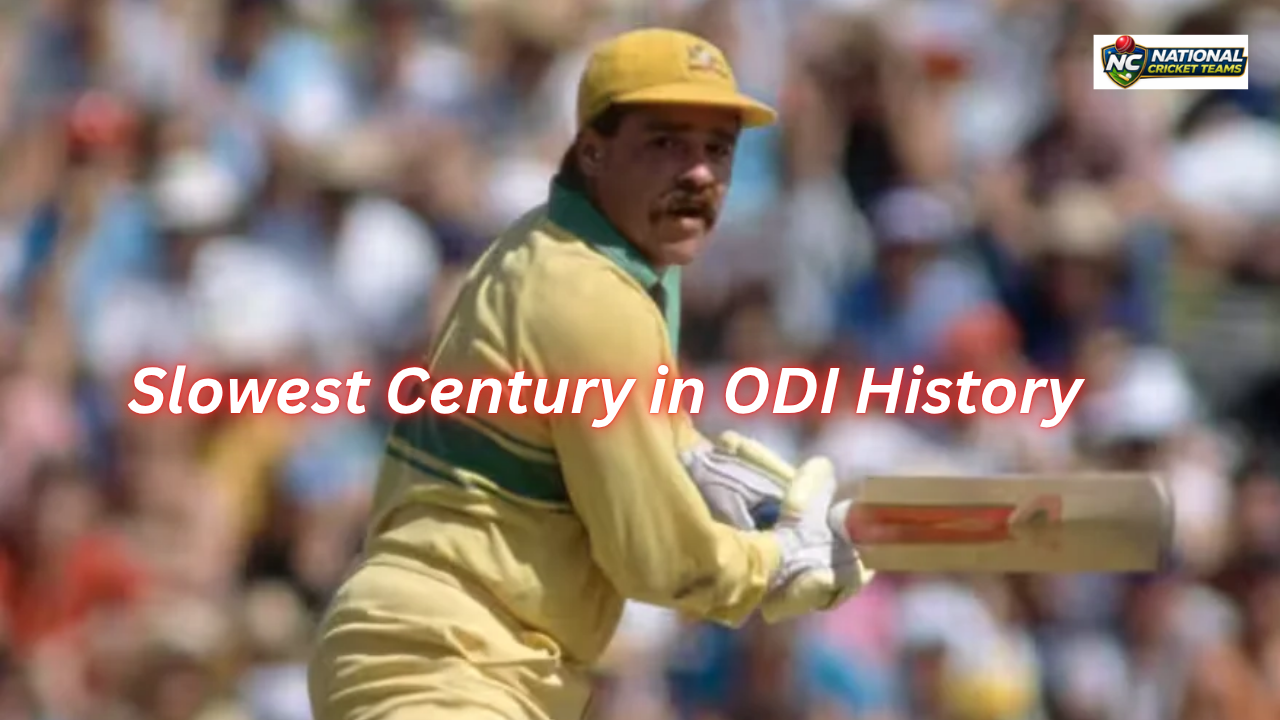
The slowest century in the history of ODI cricket is long held by Australian opening batsman David Boon. His hundred came in Hobart against India during the Benson & Hedges World Series (in 1991-92) and was made off 166 balls. Eventually, he ended on an unbeaten 102 off 168 balls and took his side home.
ODI cricket was a different game then. Teams transgressed from attacking from the first ball to preserving wickets and building partnerships. That David Boon innings encompassed the cricketing mentality at that time.
Slowest Century in ODI Cricket History – Top 10 List
| Rank | Player | Balls Taken for Century | Opponent | Year |
| 1 | David Boon | 166 | India | 1991 |
| 2 | Rameez Raja | 157 | West Indies | 1992 |
| 3 | Geoff Marsh | 156 | England | 1989 |
| 4 | Rameez Raja | 152 | Sri Lanka | 1990 |
| 5 | Scott Styris | 152 | Sri Lanka | 2007 |
| 6 | Tom Cooper | 151 | Afghanistan | 2010 |
| 7 | Geoff Marsh | 150 | West Indies | 1991 |
| 8 | David Hemp | 150 | Kenya | 2009 |
| 9 | Shai Hope | 149 | India | 2019 |
| 10 | David Boon | 146 | West Indies | 1992 |
David Boon’s 166-Ball Century Against India
The slowest innings of all time in ODI cricket still belongs to the great David Boon. With a small target to chase, Australia decided on securing the win rather than going aggressive with their batting appeal.
Boon batted for hours without taking risks, rotating the strike. He hit just a few boundaries, mainly in singles and doubles. It showed that ODI cricket in the early 90s was not as batter friendly as it is these days.
Many fans see it as a slow innings and fair enough, but that was the plan all along to help Australia win with an ease
Rameez Raja and the 1992 World Cup Record
Pakistan’s Rameez Raja maintains the mantle for the second-slowest ODI century. In the 1992 Cricket World Cup, he got his hundred versus West Indies off 157 balls.
It was on a tough pitch against a strong West Indian bowling attack. Instead of playing aggressive he was a bit cautious and wanted to save the wicket. The innings is still regarded as one of the slowest hundreds in ODI cricket, even though Pakistan went on to lose that match.
Geoff Marsh’s Defensive Masterclass
The list of slowest ODI centuries is headed twice by Australian opener Geoff Marsh. His century in 156 balls vs England, and another requiring 150 balls against the West Indies, illustrate how ODI openers operated through the late ’80s and early ’90s.
Marsh was all about his peacefulness and build an extensive innings. At the time when preserving wickets was prioritised to runs literally, his style of batting was remarkably effective.
Also read this: Jaya Bhardwaj | IPL 2026 Champions RCB | Most Fan Following Team in IPL
Scott Styris and Modern-Day Slow Centuries
New Zealand all-rounder Scott Styris is among the more recent entries on the list. His 2007 century against Sri Lanka took 152 balls to bring up.
Styris’ innings was played in difficult batting conditions unlike some of the previous slow centuries. The pitch helped bowlers and New Zealand needed consolidation not aggression. His innings showed that in the age of T20 cricket, some situations still demand the most watchful batting.
Tom Cooper’s Historic Knock
Dutch cricketer Tom Cooper reached his century in 151 balls against Afghanistan in 2010. The innings remains one of the slowest hundreds by an Associate Nation player in ODI cricket.
Cooper’s century demonstrated how players from emerging cricket nations could build innings under pressure and compete effectively on the international stage.
Why Were ODI Centuries Slower in the Past?
Different Cricketing Philosophy
During the 1980s and early 1990s, teams focused on batting through the innings rather than maximizing scoring opportunities.
Limited Power-Hitting
Modern bats are more powerful and forgiving. Earlier generations played with heavier equipment and different batting techniques.
Field Restrictions
Today’s ODI cricket includes powerplays that encourage attacking play. Earlier rules often favored bowlers and defensive field placements.
Match Situations
Many slow centuries came while chasing targets or batting on difficult pitches where preserving wickets was more important than scoring quickly.
Strike Rate Was Less Important
Modern fans closely monitor strike rates. In earlier decades, scoring a century itself was considered a significant achievement regardless of the number of balls faced.
How ODI Cricket Has Changed
Modern ODI cricket is dramatically different from the game played during David Boon’s era. Teams now regularly score 350-plus totals, and batters attack from the first over.
Several factors have contributed to this transformation:
- Two new balls from each end
- Smaller boundaries
- Improved bats
- Powerplay regulations
- Aggressive T20 influence
- Data-driven batting strategies
These changes have made extremely slow centuries increasingly rare.
Could the Slowest ODI Century Record Ever Be Broken
It is practically impossible in the current day ODI cricket to break David Boon’s record, as a batter has to score a hundred off more than 166 balls!
Scoring rates and intent to be aggressive are key priorities for teams. For a batsman to do that for a century, they would face severe criticism unless the pitch was particularly tough.
There is also a different approach, as nowadays in team management, coaches and analysts, there is a domain for strike rate including runs totals. It is extremely difficult for a batsman to bat this slowly through an innings
Slowest Century vs Fastest Century in ODI Cricket
One of the slowest — 175 balls in October 2023, less than a year later — versus one of the fastest ODI centuries,is an indication for how far the game has come.
South Africa’s AB de Villiers, meanwhile, scored 100 off just 31 balls against the West Indies in January 2015—the fastest ODI century of all-time while David Boon took a miraculous 166 to make three figures.
The huge variation captures the evolution of ODI cricket and increased focus on batting aggressively.
Interesting Facts About Slowest ODI Hundreds
- David Boon’s 166-ball century remains unbeaten after more than three decades.
- Rameez Raja appears twice among the slowest ODI centuries.
- Geoff Marsh also features twice in the top ten list.
- Most slow centuries were scored before the rise of T20 cricket.
- Only a few ODI hundreds have required more than 150 balls.
- Modern ODI batting makes such records increasingly difficult to break.
Impact of Slow Centuries on Match Results
But no matter how unattractive slow hundreds may be for audiences, they often prove to be match winning. Such innings steady batting collapses and protect wickets, to help teams post challenging totals.
A lot of names from the list of slowest century players modified their game to suit match circumstances. These performances from them sign of cricket where sometime fast is not the only way to go, patience also pays.
Conclusion
The slowest ODI hundred ever is 166 balls by David Boon against India in 1991. His record has withstood the test of time, and several transformative eras in ODI cricket for decades now.
In an era of explosive batting and record strike rates, the slowest centuries in Cricket are still crucial to our game.They prove that success in cricket as much hinges on the virtues of patience, discipline and hard work, as it does with aggression.
But with ODI cricket becoming more and more dynamic, Boon’s record does seem secure at the moment. Yes, timescale changes, and future generations may bear witness to even quicker centuries than those we’ve seen in the past 40-50 years but the slowest ODI century record will almost definitely echo through cricket as one of its most unique and long-lasting records.
FAQs
1. Who scored the slowest century in ODI cricket history?
Australia’s David Boon holds the record for the slowest century in ODI cricket history. He took 166 balls to reach his hundred against India in 1991.
2. How many balls were taken for the slowest ODI century ever recorded?
The slowest ODI century ever recorded was scored in 166 deliveries by David Boon, making it one of the most unique batting records in international cricket.
3. What is the complete list of the top 10 slowest centuries in ODI cricket history?
The top 10 list includes players such as David Boon, Rameez Raja, Geoff Marsh, Scott Styris, Tom Cooper, and Shai Hope, who all took more than 145 balls to reach their centuries.
4. Why were centuries scored more slowly in early ODI cricket compared to today?
Earlier ODI cricket focused more on wicket preservation and building partnerships. Modern rules, powerplays, and T20 influence have encouraged much faster scoring rates.
5. Can the record for the slowest century in ODI history be broken in modern cricket?
It is highly unlikely because modern teams prioritize strike rate and aggressive batting. A batter taking more than 166 balls for a century would face significant pressure to score faster.
6. What is the difference between the fastest and slowest century in ODI cricket history?
The slowest ODI century took 166 balls, while the fastest ODI century was scored in just 31 balls, showing how dramatically batting approaches have changed over the years.